
Alcohol Consumption and Breast Cancer: Is there a Link?
The short answer:
Yes , there is undoubtedly a significant association between alcohol consumption and being diagnosed with breast cancer. This is a topic close to my heart. I have a family history of breast cancer due to an unknown gene mutation. I have always enjoyed a drink. Was this a disaster waiting to happen? Perhaps, perhaps not. This article analyses the evidence to help quantify the risk.
How common is breast cancer?
Breast cancer is the second most common cancer worldwide. Cancer Research UK estimates that around 1 in 7 women in the UK will be diagnosed with breast cancer in their lifetime and that around 23% of these cases are preventable.
The incidence of breast cancer is four times higher in the developed world than in the developing world and has risen steadily since the 1970’s. Alcohol consumption in Western women has increased in the same timeframe. It is therefore a plausible hypothesis that alcohol consumption is a lifestyle factor that is positively associated with breast cancer risk. Indeed, alcohol consumption is a well established, modifyable risk factor for several cancers, including breast cancer.
What are the public health recommendations?
The International Agency for Research on Cancer (IARC) noted in 1988 that there was a substantial body of evidence that drinking alcohol is associated with cancers of the oral cavity, pharynx, larynx, oesophagus and liver. In 2007, the IARC added two of the most common cancers, breast cancer and colorectal cancer, to this list.
In 2015, the UK’s Department of Health issued a summary of the association between the consumption of alcoholic beverages and risk of cancer. Following a review of recent evidence arising since 2007, they found that the evidence for the association had continued to strengthen.
To optimise health, the Department of Health recommends not drinking more than 14 units per week on a regular basis. These drinks should be evenly spread across three or more days. If adhering to this consistently, this level of drinking would result in a little under a 1% lifetime risk of death from alcohol.
This advice aims to make the public aware that drinking any alcohol carries some risk, as of course do many other regular or routine activities, but at low/moderate levels of drinking, the risk of death from alcohol consumption is acceptably small.
For those who choose to drink more than the recommended amount, individuals should be aware that this choice carries an increased risk of serious health issues. Of course, certain individuals may be prepared to take this risk. Others may wish to reduce their risk further by choosing to drink less than the recommendations, or not to drink at all.
What does the research suggest?
The European Prospective Investigation into Cancer and Nutrition (EPIC) study is one of the largest cohort studies in the world, with more than half a million participants, mainly aged 37 to 60, and followed for almost 15 years. The burden of cancer attributable to current and former alcohol consumption was estimated using information from eight European countries. Confounders such as smoking, BMI and education were accounted for in the study design. Assuming that the observed associations were causal, this huge study found that approximately 5% of breast cancer cases were attributable to drinking alcohol.
Other studies have found higher statistics. Following analysis of the current evidence base, Cancer Research UK states that the percentage of breast cancer cases attributable to drinking alcohol is around 8%.
It should be noted, however, that a substantial part of the alcohol-attributable fraction of breast cancer cases is associated with alcohol consumption higher than the upper limit recommended by government guidelines. A 2026 systematic review and meta-analysis found a strong association, suggesting that women who drink heavily have a 52% higher relative risk of developing breast cancer than a non-drinker. It’s no great surprise that heavy drinking causes a number of health issues and indeed, many laboratory based and epidemiological studies have shown a significant association between breast cancer and heavy alcohol consumption.
However, the sobering finding from the EPIC study and other recent research is that even low to moderate alcohol consumption increases breast cancer risk. In fact, there is convincing evidence that consuming any amount of alcoholic drink increases the risk of breast cancer, both pre- and post-menopausal.
Drinking alcohol vs not drinking at all
A large, well-controlled, epidemiological study of women enrolled in the Nurses’ Health Study who were followed for 40 years, categorised drinking patterns into different totals per week, where one drink is half a pint of low ABV beer, a single measure of spirits, or a small glass of wine.
This study found that the relative risk of a breast cancer diagnosis for someone who drinks alcohol at various levels, in comparison with someone who does not drink alcohol at all, is as follows:
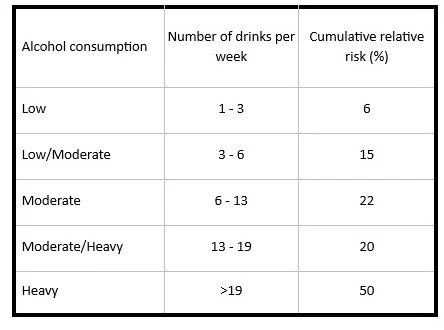
These results suggest that even a low level of alcohol consumption (1 to 3 drinks per week) was modestly but significantly associated with increased breast cancer risk.
Furthermore, for moderate drinkers consuming less than the UK government’s guidelines, the relative risk of breast cancer was found to be 22% higher than someone who doesn’t drink at all.
OMG!! Pass me the lemonade!!
These statistics sound pretty shocking and indeed are useful in grabbing attention. However, relative risk is not the same as absolute risk and figures such as these, whilst correct, can be misleading.
Although an individual who drinks alcohol has a significantly greater risk of breast cancer than someone who is tee-total, the likelihood of a breast cancer diagnosis attributable to drinking alcohol at a low/moderate level is still arguably very small.
Using approximate figures for illustration purposes, research suggests that women consuming a low/moderate amount of alcohol on a regular basis (the amount in line with the government’s recommendations), increase their breast cancer risk from approximately 13% to 13.4% by doing so. For many, this small increase in risk is an acceptable price to pay for a few glasses of wine at a weekend.
Overall, including all levels of alcohol consumption, from low to heavy, a woman’s absolute breast cancer risk increases from about 13% to 14.2% by regularly drinking alcohol. Women who drink alcohol more heavily than government guidelines may therefore wish to assess whether they are comfortable with this increase in risk.
Are all types of alcohol equal?
In terms of cancer risk, yes! Research suggests that increased breast cancer risk is associated with all types of alcoholic drink, that is, beer, wine and spirits show similar associations.
This may come as a surprise, as 87% of people in the UK are not aware that drinking red wine increases the risk of cancer. The benefits of drinking red wine for heart health are less than previously thought and are outweighed by the harmful effect alcohol has on cancer risk.
'Little and often' vs binge drinking
Although there is limited scientific research considering the effect of different styles of drinking on breast cancer risk, in the Nurses’ Health Study, both regularity of drinking and binge drinking (which was defined as consuming more than four drinks at a time) were strongly associated with breast cancer risk.
But I don’t drink like I used to!
Cancer is a genetic disease, arising from inherited or acquired mutations to the DNA. It is estimated that only around 5% of mutations are inherited, the rest are caused by the environment or lifestyle factors, and nutrition undoubtedly plays a part.
There is evidence to suggest that cancer can arise years or even decades after the damage is done to DNA. This suggests that drinking alcohol as a young person may increase the risk of a cancer diagnosis many years later.
Some researchers have suggested that there may be a critical period of increased biological vulnerability between the onset of puberty, when breast tissue undergoes rapid proliferation, until the completion of the first pregnancy, after which time multiple biological changes in the breast occur and make epithelial cells resistant to becoming transformed into cancer cells. If this is the case, alcohol consumption in younger women would be particularly significant for later cancer risk.
Analysis of data from the Nurses’ Health Study supports this suggestion. Drinking levels before the age of 40 and after age 40 were both found to be significantly associated with breast cancer risk. The association with drinking in early adult life still persisted even after controlling for alcohol intake after age 40, that is, if an individual reduced their drinking habits in midlife, this did not reduce their risk accordingly.
Please tell me the research is not true!
All academic research is subject to limitations. As with most studies of dietary intake, studies which consider the link between alcohol and breast cancer depends on self-reporting of intake to determine the amount and type of alcoholic beverage consumed. People find it notoriously difficult to accurately recall dietary information, and this is especially so with alcohol consumption. It is therefore possible that the apparent risk of cancer among low/moderate drinkers may be partly due to the under-reporting of intake, that is, these people are actually moderate/heavy drinkers.
In most studies of alcohol intake, little attention is paid to drinking patterns. Much of the research considers typical total intake over a certain timeframe, such as a week or a year and does not take into account binge drinking for example. The lack of systematic information about drinking styles makes it difficult to accurately assess results.
Furthermore, it is thought that cancers often develop over decades, so it is possible that many of the cancers that were diagnosed during the cohort studies may have been initiated before many people even enrolled to take part.
What is the biological basis of the association?
Despite a consistent association between alcohol consumption and breast cancer risk, the underlying mechanisms remain unclear, although a number of plausible suggestions have been proposed by the scientific community.
It is widely accepted that prolonged exposure to oestrogens is related to the elevated incidence of breast cancer in humans. Several studies have shown that consumption of around 20 alcoholic drinks per week raises a woman’s circulating oestrogen levels. This may promote the proliferation of already initiated breast tumours.
Another possibility is that alcohol is a weak cumulative carcinogen, due to carcinogenic products of alcohol metabolism, such as acetaldehyde and reactive oxygen species.
Emerging evidence suggests the impact of alcohol on DNA methylation and therefore alterations in how genes are expressed has been recognised as an important component of cancer development.
Alcohol consumption can cause a folate deficiency. Low levels of folate are a well-documented risk factor for breast cancer, with some studies suggesting an interaction between folate and alcohol affecting breast cancer risk, but evidence is not consistent across the literature.
In short, the biological mechanisms behind the observations statistically observed is an area which requires further research. A better understanding of how alcohol consumption increases breast cancer risk is crucial for developing breast cancer prevention strategies.
Does drinking alcohol increase the risk of breast cancer recurrence?
Researchers are still trying to understand how consuming alcohol after a breast cancer diagnosis affects the risk of breast cancer coming back. Although the results are mixed and require further research, the guidance states that women who have already been diagnosed with breast cancer should follow cancer prevention guidelines, including reducing alcohol intake. Data about whether survival outcomes are impacted by drinking alcohol are also mixed and require further research.
Overall, what is the weight of evidence?
Epidemiological studies are by necessity associative and cannot determine cause and effect relationships. Despite a vast amount of evidence in the literature, it is still unclear what the precise relationship is between alcohol and breast cancer.
However, taken as a whole, there is ample and generally consistent evidence, from cohort and case-control studies, that any type of alcohol consumption, even at low levels, increases breast cancer risk in both pre-menopausal and post-menopausal women. Furthermore, there is a dose-response relationship, that is, as total alcohol consumption increases, breast cancer risk increases.
The scientific evidence does not show any ‘safe’ threshold for alcohol intake in terms of breast cancer risk. It is clear that cancer risk increases as alcohol consumption increases, but the threshold level of alcohol consumption above which the increased risk of breast cancer becomes clinically significant remains unclear. Thus, knowledge that an association exists, if deemed causal, is not sufficient to make public or personal decisions. Such actions require more detailed knowledge of the shape and quantitative aspects of the dose-response relationship.
Broadly speaking, public health initiatives from many respected organisations, such as The European Health Alliance on Alcohol, which was launched in 2025 by the World Health Organisation, advocate limiting alcohol consumption to mitigate cancer risk. There is certainly no harm in anyone following this guidance.
As scientific knowledge advances, the public health message regarding safe thresholds for alcohol consumption may be clarified. In the meantime, for a number of health reasons including reducing breast cancer risk, if an individual drinks more than the current government recommended amount of alcohol per week, they may consider reducing their total alcohol consumption.
Was alcohol to blame for my own breast cancer?
In terms of hereditary breast cancer, the interaction between gene mutations and alcohol consumption is still controversial. A study of nearly 6,000 white and black women suggests drinking alcohol doesn’t worsen the risk of breast cancer from a genetic mutation. Overall, research suggests that people with such abnormalities cannot alter their genetic risk by altering alcohol intake, although evidence is still limited, mainly due to the small number of study subjects.
Had I known in my young adult life that a) I had a genetic mutation and b) that there is a convincing link between alcohol consumption and breast cancer, would I have changed my drinking habits? Perhaps. Would reducing my alcohol intake have prevented my breast cancer diagnosis? Probably not.
Over the years I have personally chosen to reduce my alcohol intake in an attempt to lower my risk of cancer, and also obesity, heart disease and type 2 diabetes. Nowadays, for example, I enjoy drinking when out with friends on a Saturday night as I have always done, but I very rarely partake in a glass of wine while sitting on the sofa throughout the week. Introducing several alcohol-free days per week is one practical way to reduce risk of breast cancer and other health issues.
Of course, many people obtain benefits from drinking alcohol, including social pleasure and relaxation, and do not want to give it up completely. I am one such person. Furthermore, everyone’s interpretation of risk, and response to managing risk is different. I have always taken some risks to live my life in a way I enjoy, whether that is snowboarding off piste or drinking alcohol in a mountain bar. Everyone has the freedom of choice… so I’ll leave it up to you to decide how often to pop that cork.
For more information about cancer prevention, check out more free cancer resources on this website:

Hi I’m Helen
A Registered Nutritionist, experienced speaker, coach and writer, I love supporting people to change their relationship with food.
Contact me HERE with any questions you might have.